
Company
Self project
Timeline
2025
Role
Product designer
UX Strategy
AI Experience Designer
Audience
U.S. Veterans filing initial or supplemental VA disability claims
Overview
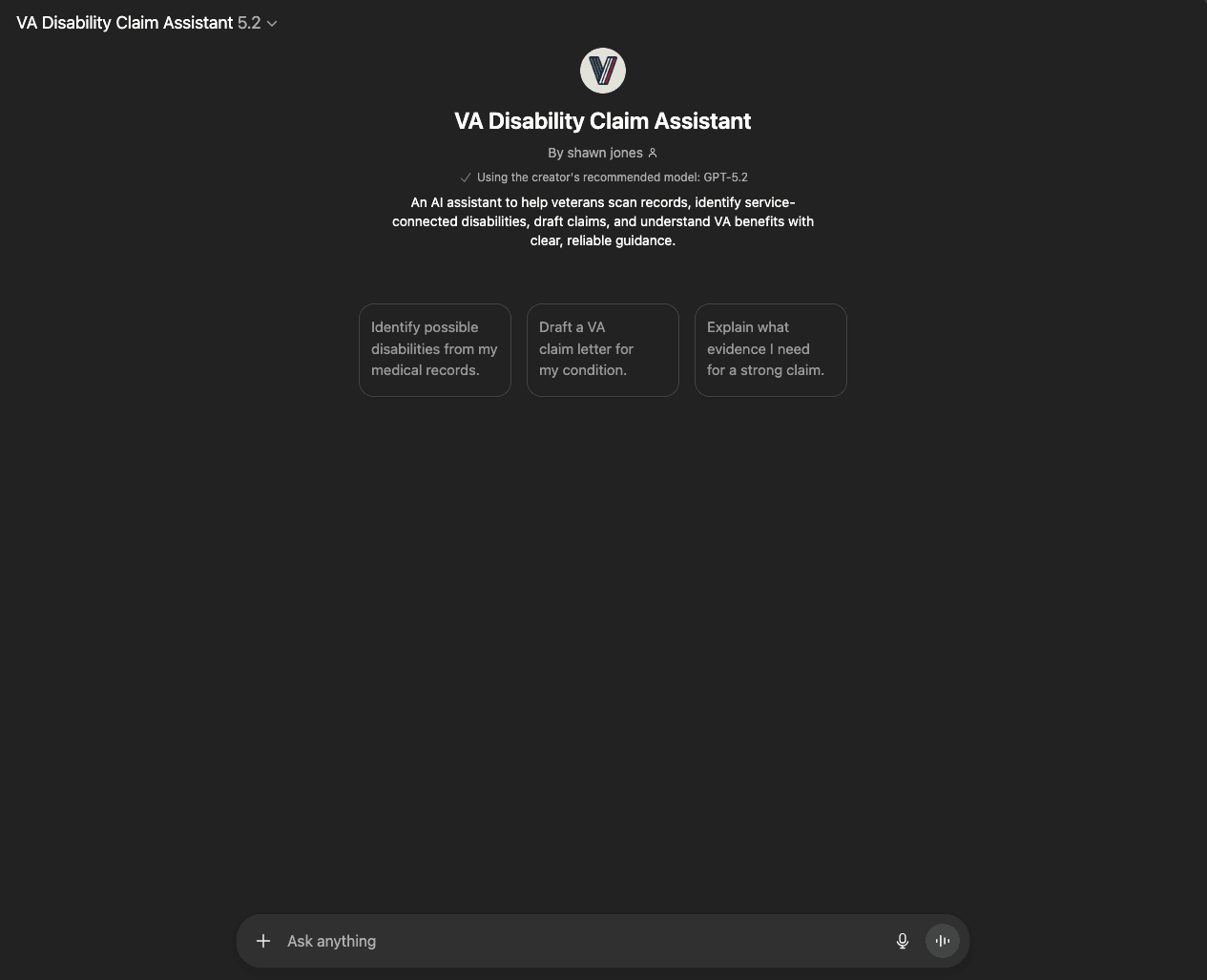
The VA Disability Claim Assistant is an AI-guided experience that helps veterans prepare, organize, and complete VA disability claims with greater confidence and completeness. The product translates complex VA language into plain English, guides veterans through evidence and narrative building, and outputs a claim-ready package aligned to how claims are evaluated.
Check out the VA Disability Claim Assistant.
Problem area
The disability claims process is overly complicated and taxing
Filing a VA disability claim is a high-stakes, emotionally charged process that many veterans find overwhelming. The system is technically accessible, but cognitively and procedurally difficult.
What’s broken:
The process assumes veterans already understand what counts as evidence
VA terminology (nexus, service connection, secondary conditions) creates friction
Veterans struggle to translate lived experience into structured documentation
Mental health and exposure-related claims are especially hard to articulate
Why this matters (context):
Roughly 30% of U.S. veterans receive VA disability compensation
Among those receiving benefits, ~15% are rated at 0–10%, even though many have additional or secondary conditions that are never fully claimed
Underrating often stems from missing documentation, incomplete narratives, or unclear service connection, not lack of eligibility
This creates a gap where veterans engage the system, but still leave value, care, and recognition on the table.
Design challenge
How might we help veterans
The solution
Turn hours of guesswork into guided progress with AI
An AI assistant designed as a calm, structured companion, not a chatbot, focused on progress, clarity, and trust.
Core Experience Principles:
Guided > Conversational
Veterans don’t need open-ended chat. They need direction. The assistant uses structured flows and progressive disclosure to reduce cognitive load.Evidence-First Design
Every question maps to a claims requirement (diagnosis, severity, nexus, onset, continuity). The system continuously builds an evidence checklist and flags gaps.Narrative Support, Not Automation
The assistant helps veterans draft clear, factual statements while keeping the veteran in control. Nothing is submitted automatically.Trust & Guardrails
Clear disclaimers (not legal or medical advice)
Transparent reasoning (“why we’re asking this”)
Links to official VA resources and forms via the U.S. Department of Veterans Affairs
Key features
AI-guided preparation for a claim-ready experience
MVP Scope
Clear understanding of process and expectations
Single-claim flow (initial or disability increase).
Evidence checklist and narrative drafts (ie, PTSD Claim letters).
Readiness and rating scoring (Estimate of rating based on evidence).
VA resources linking (no submission handling, since everything must go through VA).
Design outcomes
Designing confidence, clarity, and claim Readiness
While this project is early-stage, I wanted to improve a few areas of friction:
Reduced ambiguity by converting an abstract process into a checklist-driven flow
Higher confidence through progressive completion and visible progress
Improved completeness by explicitly surfacing secondary conditions and documentation gaps
A scalable pattern for applying AI to complex, regulated workflows without over-automation
Metrics I would track
What I'd like to achieve
Claim-readiness completion rate.
Average time to “claim-ready” state.
Evidence coverage score (before vs. after).
Drop-off by step (where veterans get stuck today).
Self-reported confidence before vs. after using the assistant.
Learnings + self reflection
Why this work matters to me
As a veteran, I’ve seen firsthand how easily qualified people fall through the cracks, not because they lack eligibility, but because the system demands clarity at a moment when clarity is hardest to find. This project explores how thoughtful AI design can reduce friction, restore agency, and help people advocate for themselves more effectively.