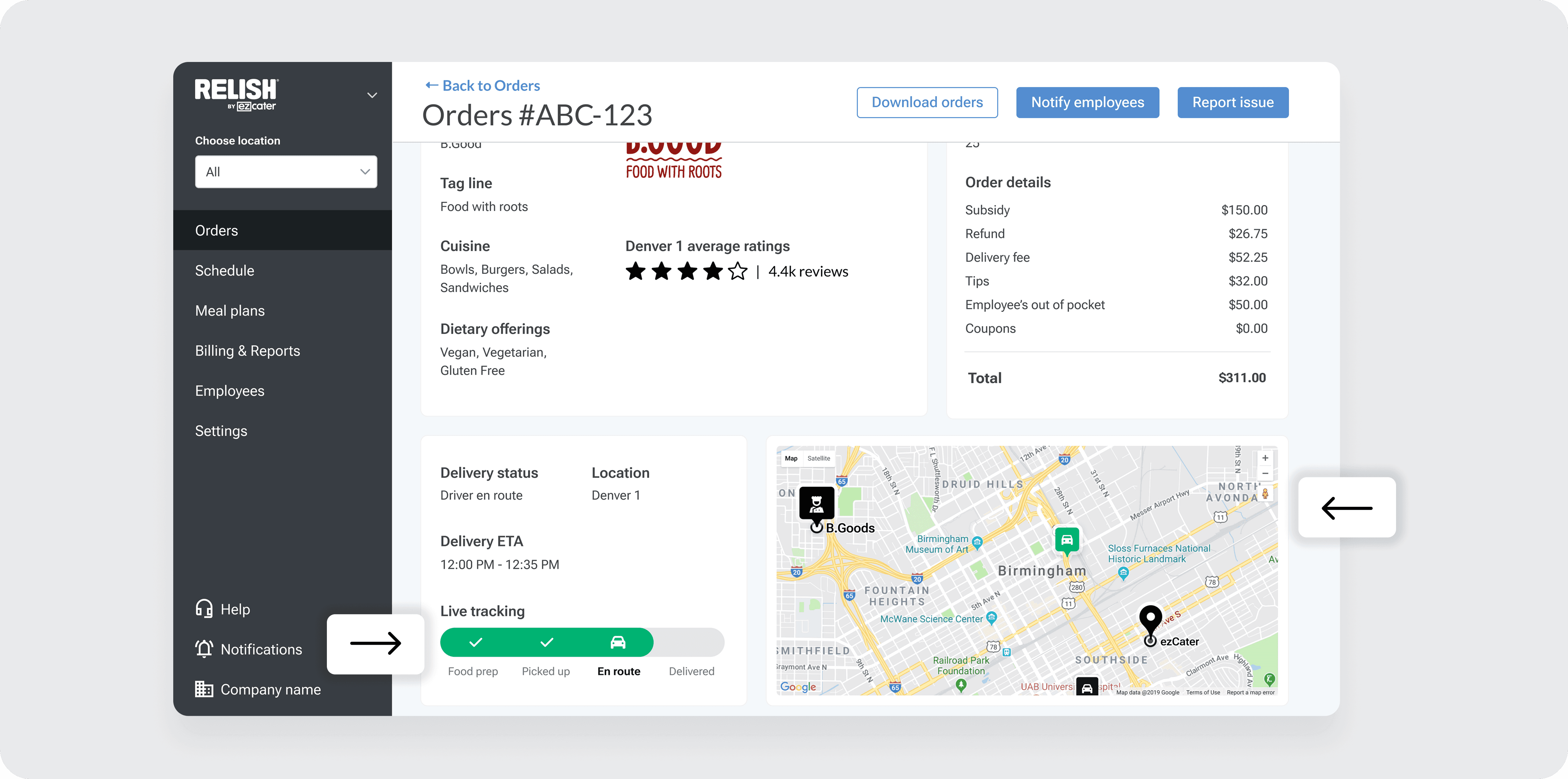
Driving 7× GMV growth powered by self-service ordering and admin visibility
Relish by ezCater is a corporate employee meals program that simplifies recurring meals and food logistics by bundling individual employee selections into a single delivery. Our current Relish admin experience was rigid, poorly labeled, and largely view-only, forcing admins to contact support for everyday tasks and limiting Relish’s appeal to larger, enterprise-scale customers.
B2B SaaS
UX research
Product design
Product strategy
Usability testing
Information architecture
FoodTech
Year
2021
Role
Product design leadership
Product strategy
Research synthesis
Cross-functional facilitation


Simplicity isn’t useful when we remove all functionality and provide a view only experience to a highly active business.
As Relish usage grew across companies of various sizes, the existing admin experience no longer matched how office admins worked.
Key issues
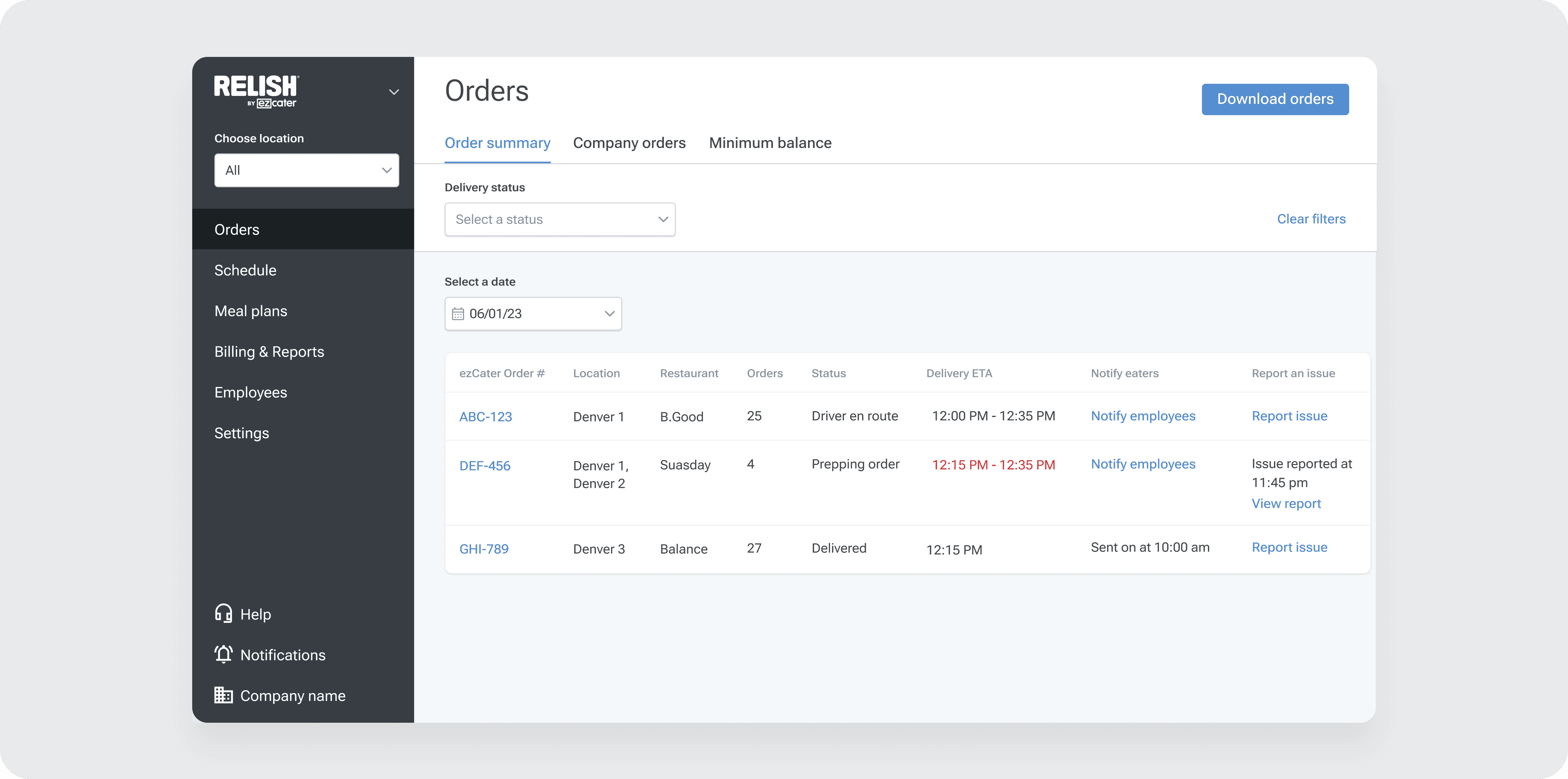
Rigidity and lack of flexibility: The calendar-first design failed to support one-off meals, ad-hoc scheduling, or changing office conditions.
Limited self-service: Admins had to contact support for routine tasks like updating employee lists or company info, increasing friction.
Opaque spending and billing visibility: Lack of clear views into budgets and spending, limited spending confidence, and limited program expansion.
Feature discoverability problems: Navigation, labeling (e.g., My Office), and dashboard structure inhibited the adoption of admin features.
Rigidity and lack of flexibility: The calendar-first design failed to support one-off meals, ad-hoc scheduling, or changing office conditions.
Limited self-service: Admins had to contact support for routine tasks like updating employee lists or company info, increasing friction.
Opaque spending and billing visibility: Lack of clear views into budgets and spending, limited spending confidence, and limited program expansion.
Feature discoverability problems: Navigation, labeling (e.g., My Office), and dashboard structure inhibited the adoption of admin features.
The core strategic question was:
How might we design an admin experience that empowers Relish customers to self-serve confidently, reduce their reliance on support, and unlock new corporate partners?
I defined clear design goals to guide decision-making and shape product direction and priorities
Self-service adoption
Shift routine admin tasks from support to self-serve to reduce support volume and friction.
Support ad-hoc ordering
Enable one-off and ad-hoc meals to increase order frequency and GMV.
Spend confidence
Provide clear visibility into spend and upcoming orders to drive program expansion.
Boost feature usage
Clarify navigation and intent to increase adoption of admin tools.
Increase order accuracy
Ensure reliable menu and favorite data to reduce order issues.
Scalable operations
Reduce support dependency while enabling Relish to grow efficiently.
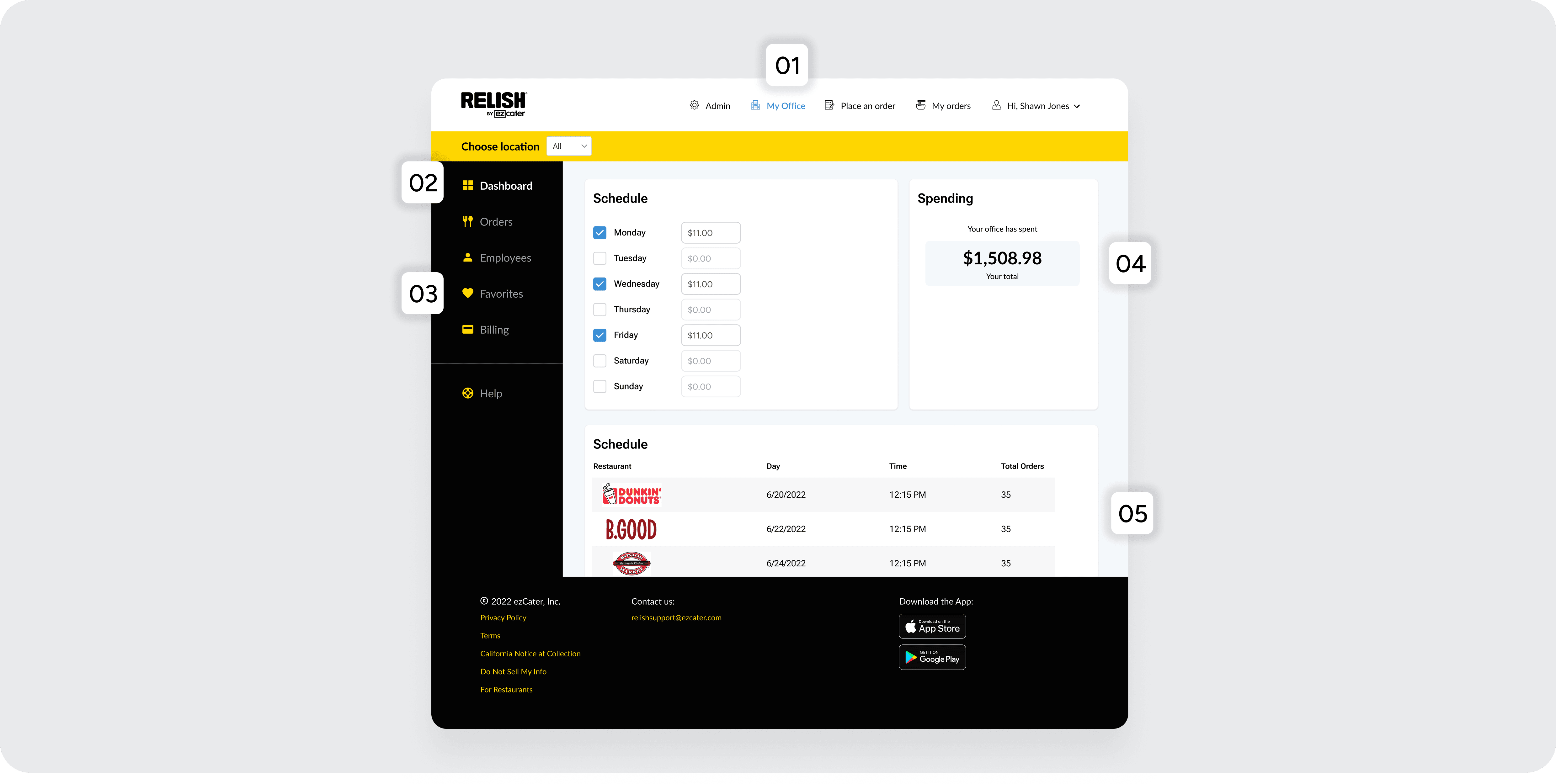

Opportunity 1
Unclear labeling (“My office”) resulted in low adoption and usage.
Opportunity 2
Dashboard was used most to check order and delivery status.
Opportunity 3
Favorites lacked accurate data, causing unhappy orderers.
Opportunity 4
Favorites lacked accurate data, causing unhappy orderers.
Opportunity 4
Favorites lacked accurate data, causing unhappy orderers.
Opporunity 4
Admins wished they had more visibility into spending and billing.
Opporunity 5
Admins wished they had more visibility into spending and billing.
Opporunity 5
Admins wished they had more visibility into spending and billing.
Opportunity 5
The calendar view didn’t support one-off ordering requests.
Opportunity 6
The calendar view didn’t support one-off ordering requests.
Opportunity 6
The calendar view didn’t support one-off ordering requests.
We set out to interview 15 company admins of different sizes and needs to determine that they all want the same thing: flexibility, the ability to make simple updates to employees, and visibility into their orders.
Admins had different roles across the organization.
To ground design decisions in evidence and real user context, I led a discovery phase involving:
Admin interviews and observational research to understand how admins attempted daily tasks with the old portal.
Workflow mapping to identify where friction, repetition, and confusion occurred.
Support logs analysis to quantify common pain points and reasons for support calls.
To ground design decisions in evidence and real user context, I led a discovery phase involving:
Admin interviews and observational research to understand how admins attempted daily tasks with the old portal.
Workflow mapping to identify where friction, repetition, and confusion occurred.
Support logs analysis to quantify common pain points and reasons for support calls.
Admins prioritized flexibility over simplicity
Research showed that office admins didn’t want a “simple” experience, they wanted one that matched their real workflows based on their jobs (office managers, financial admins, etc). Rigid, calendar-based tools broke down when needs changed, making flexibility (one-off meals, ad-hoc scheduling, updating company settings like office closures) more valuable than minimal UI.
Admins and employee orderers had different needs
Research showed a clear split between admins and orderers. Admins needed control over budgets, policies, and visibility, while employee orderers prioritized variety of cuisine and restaurant. Because the product tried to serve both roles in the same workflows, it created friction and hesitation, highlighting the need for clearer role-based experiences with defined guardrails.
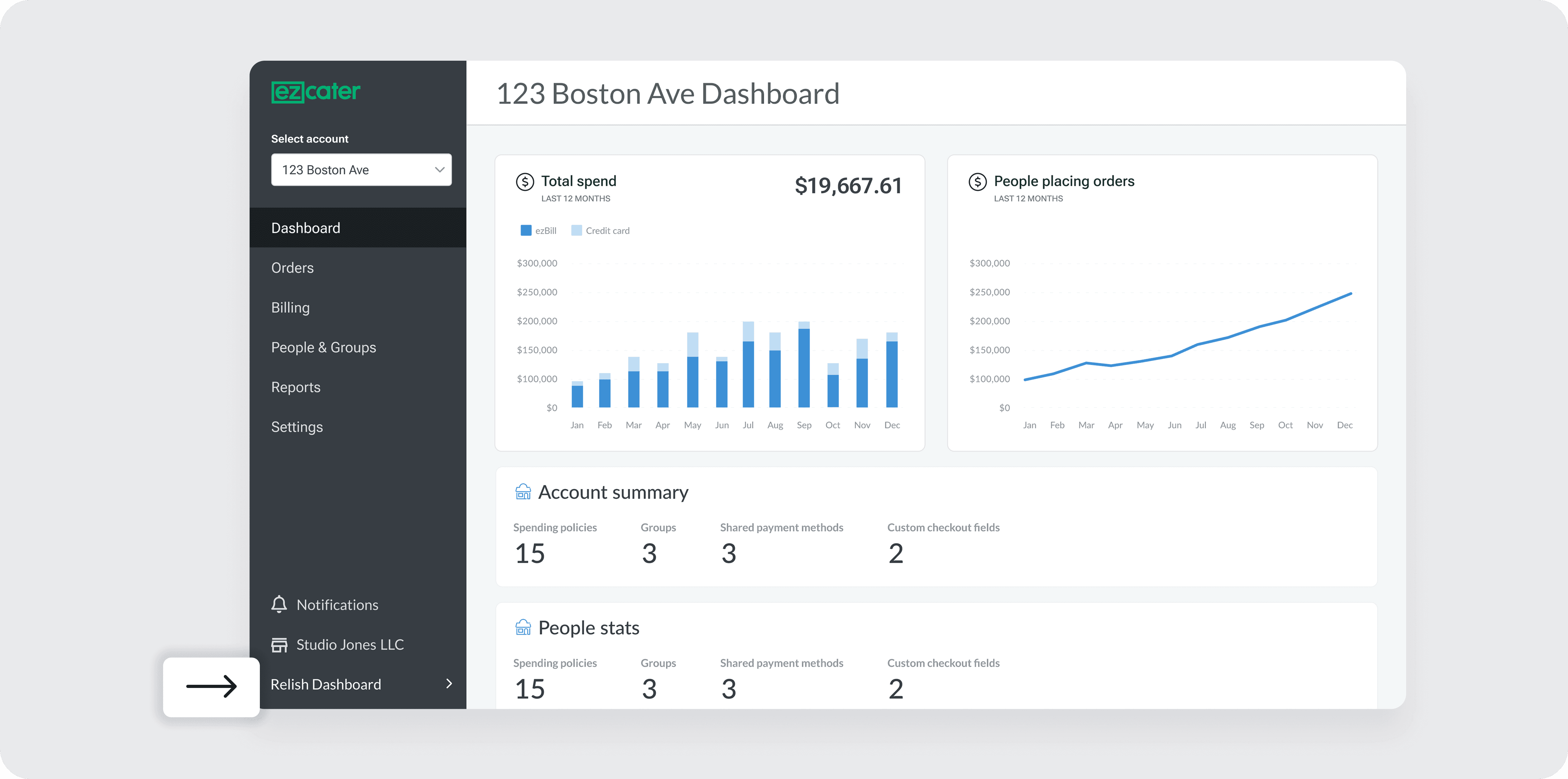
Unified admin experience within ezCater’s corporate tools.
I consolidated Relish admin tooling into ezCater’s broader corporate admin ecosystem, reducing context switching and enabling shared patterns across products. This helped admins manage Relish alongside other company programs seamlessly and coherently. This increased cross-product admin usage by 32%, and lowered admin-related support tickets by 20%, while laying the foundation for a unified ezCater brand.


Built customer trust through visibility into orders and delivery status.
Understanding that uncertainty drives frustration, I introduced in-product visibility for order status, delivery progress, and spend tracking. Clear feedback reduced unnecessary support calls and increased admin confidence in managing meal programs.


Improved admin confidence and control by adding self-serving functionality to customize their employee meal program.
Rather than forcing a calendar-centric mindset, I reoriented the admin experience around real office workflows: budgeting, employee management, one-off orders, and schedule adjustments. This improved efficiency and enabled admins to complete tasks they had previously outsourced to support.
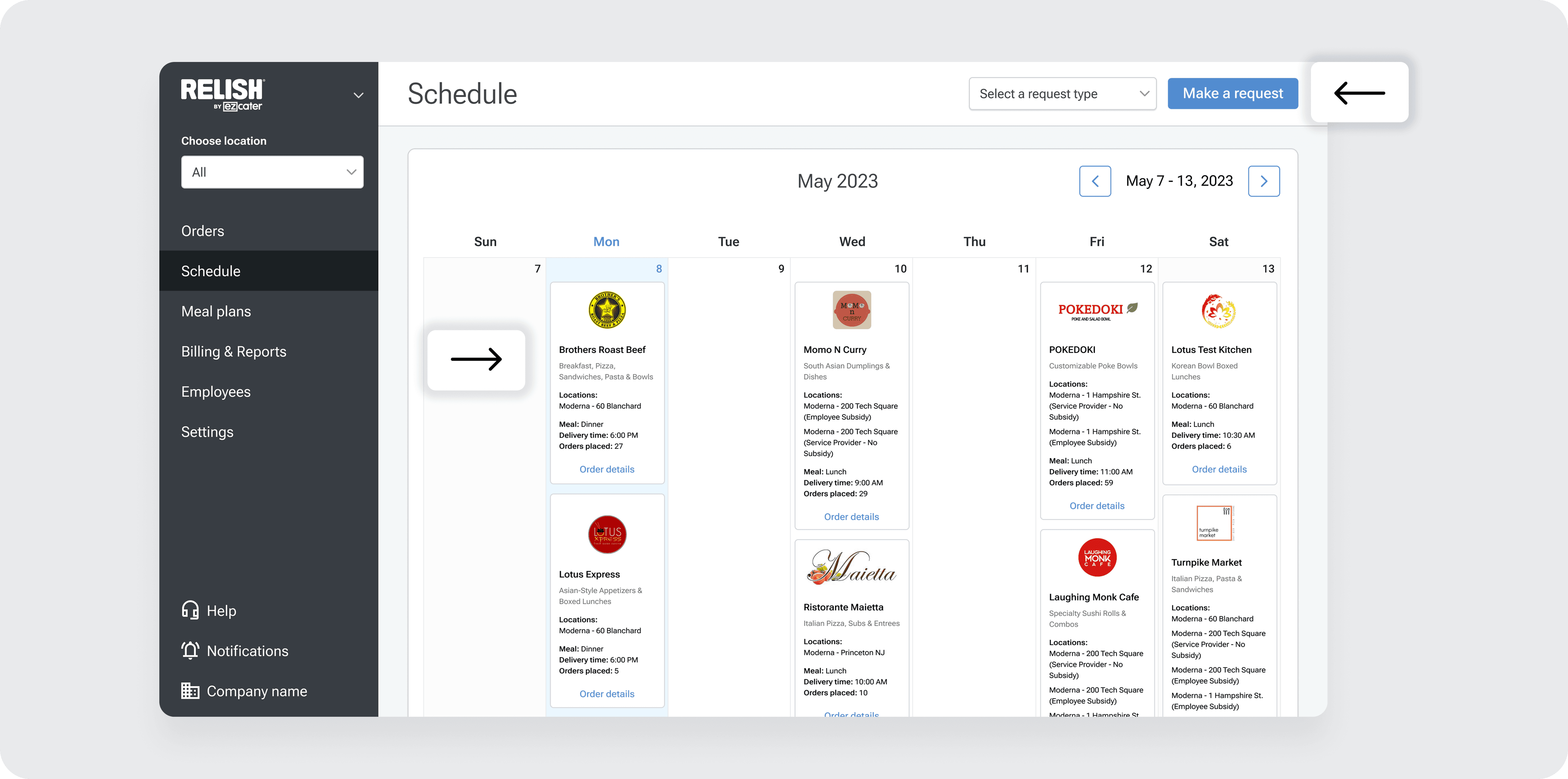

Turning strategy into shippable systems.
I collaborated closely with product leadership, engineering, and support teams to:
Translate UX intent into robust interaction specifications
Prioritize backlog items that unlocked the most admin value
Use iterative usability tests to validate assumptions and refine key flows
Cross-discipline design syncs ensured alignment on system constraints and opportunities, and structured handoff documentation minimized ambiguity during implementation.
Transforming a simple tool into a useful experience.
This project reinforced for me that scaling a product is often less about adding features and more about removing friction. Relish didn’t need more complexity; it needed clearer, more unified tools that respected how admins actually operate. By aligning teams around real workflows and unifying fragmented admin experiences, we shifted from reactive support-driven solutions to proactive, self-service ones.
As a design leader, one of my biggest learnings was the importance of platform thinking over product thinking. Moving Relish into ezCater’s shared admin tooling required deep cross-functional alignment and long-term vision, but it created leverage, enabling faster iteration, consistent patterns, and easier onboarding for enterprise customers. That foundation directly unlocked new corporate partners, opening industries we previously couldn’t serve due to strict operational requirements.
This work showed how closely design decisions and business outcomes are connected. By designing for admin confidence, transparency, and scale, the redesigned experience contributed over $30M in GMV. It reinforced my belief that strong design leadership isn’t just about craft, it’s about building systems that earn trust, enable growth, and create lasting impact.
Wins and outcomes
These outcomes showed that the work wasn’t just a UI polish; it fundamentally changed how offices managed Relish, unlocked corporate partners, and reduced operational friction. This initiative drove 7x GMV ($30M) growth with these new admin features. We saw a 20% reduction in support calls due to the self-service functionality that we added to the Relish admin experience.
“Managing Relish used to mean workarounds and support calls. Now I can handle simple updates in minutes. We cut admin time by ~30%, and last-minute requests are no longer stressful.”

Rachel W.
Office Manager, Pfizer
“The new admin tools gave us clear visibility into spend and orders across ezCater and Relish. Reconciliation is faster, budgets are easier to manage, and reporting time dropped by significantly.”

Leon C.
Financial administrator, JP Morgan